WE WILL NOT BE UNDERSTOOD
Showing posts with label existentialism. Show all posts

Monday, April 9, 2018

Donnie Darko: Holiness through Fatalism in a Post-Religious Era

Summary: I think one of the lesser-discussed messages behind Donnie Darko is: We can replace God with a romantic notion of universal fatalism.
------------------------------------------------------

"Donnie wakes up in his bed laughing after dreaming some of the events within the TU. He then goes back to sleep seemingly content with life now. The experience has seemingly brought him closer to God and he is no longer afraid to die. The jet engine Donnie sent through the time portal now falls into his bedroom killing him."

Easily the best movie of all time.

The greatest thing about Donnie Darko is that it uses fatalism to add a holiness to existence in a post religious society. And it does this in so many ways, through the directing, and a masterfully crafted plot that exists on many layers, somehow still haunting the user with this holiness on each one. It evokes one with the eerie but infinite astonishment about the world that Heidegger characterizes as fundamental to Dasein. Like a fascination with your very existence in the world, as a self at this time and place for no apparent reason. In this case it is evoked by playing with the meaning of your story in the universe through manipulations with time and choice that can imbue a weird sense of destiny on everyday living. One must ask: why does Donnie die laughing?

the story exists on two levels
1.
i think from just watching it, without seeing the director's cut or anything, you see a guy who falls into a horrible series of events

and is questioning death and being alone, and having issues with that

and goes through a series of events and seems to understand something, or realize something
especially after the series of events is so pointedly terrible (like the universe is sending him a message), and occurring in this dreamlike sequence
and when he wakes up, back at the beginning of it all
he sacrifices himself so all those bad things dont happen to everyone
and he goes happily, feeling that there is some greater sort of timeline, a holier connection with the universe and his story as he had hoped for. the universe "spoke," so to speak.
and that evokes this notion that he is "closer to god so more okay with dying," which is something that every human ultimately wants. It's harder and more evasive to get in a post-religious era, and that's why Donnie Darko is mysterious and evasive itself at times. But it allows for that possibility using the story of your life in the place of the story of humanity, no greater deity needed...after all, he could have dreamt the whole thing. But it's this notion of fatalism that, through backward time travel from the end of your life, breaths meaning onto your present.


2.
the second layer is when u actually learn the philosophy of time book that this is based off of, and realize theres a structure and ruleset to everything thats happening
at the start they break into a tangent universe, and the universe is doomed
donnie is the chosen one, and his goal is to return the extra engine that dropped on top of his house
and everyone in that tangent universe is subconsciously guiding him to send that extra engine out of the universe so it can collapse safely, without forming a black hole. It's incredible how every single interaction in that movie is meant to lead Donnie to his destiny, it gives a powerful sense of purpose to every human interaction he has, one that the viewer feels even if he doesn't know about this deeper layer to the plot, probably from the incredible visual directing and acting.

 And it is from this beautiful perspective we can derive a sort of fatalistic maxim to live one's life in a post moral and religious society: we dont need god: just treat everyone in a way that they are subconsciously guiding you toward a fate to save the universe. This notion of a "meant timeline," and of a mysterious force leading the humans you interact with to guide you to your Great Task, ultimately death--but one in which you are happy to go, is a beautiful way to look at your life, and it's why Donnie laughs in his last moments--one must imagine Sisyphus happy. While it literally happens to Donnie, I really think this is just a metaphor for life--a tangent universe that you explore until you happily accept your fate. Follow the queues of your fellow humans--all interactions holy.


And as a follow-up, you could even interpret this without the force! The laugh works on so many levels, and even the most bare (which may make it the most powerful, existentially), where he basically realizes his fate as the Living Receiver and is brought into a feeling of holy communion with the universe (think Stranger from Camus), and even though he doesn't need to die--since the airplane wing has already been returned the primary universe is now restored and he can choose whether to go or not--he is okay with dying, because his role as the living receiver is even greater in death, and he sort of realizes that its all about choosing your story, and punctuating your fate on The Timeline, and laughs in those last moments.

Saturday, April 7, 2018

The Correlation Between Philosophy and Politics

Part 1
One of Heideggers ideas is this idea of the Gay man. Where like the truly free man has recognized his condition and that he will never be fulfilled in this higher sense, and this gives him a radical freedom and unshakeable joy
Now, what the gay man does need not change, but it’s how he does it
He no longer expects a permanent fulfillment from his projects, he just does them for the sake of doing them
Now, it’s important to note here that the gay man does not drop his projects, because if he did it would be like admitting that he expected meaning out of them and got disappointed
He simply “sticks to things without getting stuck to them”
So I was thinking about how heidegger uses the specific term “projects” here
Camus has an almost identical formulation
Where he’s like should I kill myself or drink a cup of coffee
Aka once you confront the absurd, the futility of the world doesn’t actually direct you to kill yourself, it’s just one option among many
And in fact using that as an excuse to kill yourself would NOT indicate a confrontation w the absurd, since it implies that you were “disappointed” by the futility and therefore assign value to it
It’s the same point, but much more coldly and rawly stated, and he doesn’t use the term “projects”
It’s almost like Heideggers is more obviously a state brainwashing tactic
Where the goal is to convince disillusioned youths to not drop their projects but still gave value to their depression
But still give*
And you can make an argument that Sartre and Camus were doing this for the left, and H was doing it for the right
And on top of that, Sartre and Camus had complementary shortcomings
Camus was a poet of life who wished he had more pull w the academic community
Sartre had the whole community at his feet but always lamented not being able to use words with the right type of sincerity and passion (poetry)
Heidegger had both in one package, an analytically sound but still poetic-passionate view of man
I wonder if you can correlate this philosophical victory to the rise of the fascist right at that time...
Both of them were using existentialism to appeal to depressed youth, just for different sides.
I wonder if this is happening now with the victory of Sloterdijk…
That’s the first major point.


Part 2
The second part of this meditation: its interesting when you connect this to our other discussions on sort of, the role of certain philosophical concepts and propagation of them in grooming fascist tendencies to take over.
Wherein, we frame it as, certain types of thought, having to do with void, failure of liberalism, return to the tribe/myth, secrets of the unconscious, self-reliance, etc tend to fuel of rise of fascism in the country they are propagated
But in the existentialism case, the same concepts were being used to fuel both sides of the political spectrum!
So maybe this DOES imply a non-correlation between Phil concepts and their political consequences
It’s just how they’re marketed and who they’re marketed to that makes the difference

Part 3
Now, on first glance, you might think that this sort of allows us to hate on Heidegger for being a Nazi without burying his ideas; he just marketed great ideas for a bad cause (let's say intentionally or unintentionally for now, thats a different discussion). 

BUT, then you can argue "okay, doesn't that imply that heidegger's ideas, in his formulation, are still marketed towards bad things, and therefore his writings, as written, are bad?"
Which leads to the question: How do we distinguish his concepts from his framing of them?
Ironic, because this struggle between the framing of beings and the Being of them is an issue he really worked through.

It also leads to the question "can one just preach philosophy in a vacuum?"
is it always inherently directed at a political audience, with its own ideology, even if the author doesn't intend it?
Is philosophy a scalar or a vector?

If this leads you to think "well, the author has his intentions, but after he writes it, the book becomes its own new thing since hermeneutics and transcendent idealism etc etc." then I challenge you yet another time: this would imply that camus or sartres formulation of existentialism, having similar concepts to Being and Time but marketed to the more inclusive Left, is the "good" version of the text. But then, why is Being and Time the preferred version that's still used as the canon, by a mile? Clearly its content goes above and beyond its marketed political effect... and a second challenge on that, wouldn't this be like saying that the Bible was a better version of reality than Epicurious' much more accurate account of reality at the time, because the Bible placated the masses and led to less violence, aka had better political consequences?

Friday, April 6, 2018

The Reversed Role of Modern Working Art: Pulling Us Out of the Void

pre WW2, the goal of working art was to unconceal the earth from underneath us, and present it as such
for example painting obscene pictures of naked old people, because no one likes thinking about that, its hidden from our daily life, we push it away
its a concealed earth that we walk on and are oblivious too and rely on its concealment in order to maintain comfort
and this is heideggers definition of working art, and it makes sense
and i think in his era, the important thing to do (a la deconstruction) was pull people out of the romantic and into the void that they were repressing
romantic/classical, depending on whether you were religious or technical etc
but in any case the "earth" in this case was the uncomfortable void that everyone was ignoring
and people more or less do the same thing today, but what if its the opposite?
we've confronted the absurd formally ever since camus/sartre, and have been DEFAULT in the void
so working art is now about pulling us out of the absurd and back into the romantic
reminding us that feelings are still real, and things DO matter, even though we dont want to admit it
this meditation was inspired by this track:

Tuesday, April 3, 2018

Great Nihilist Responses to the Question of Suicide


The question is "Why should I remain alive?"


Great Nihilist Responses (from Camus meme stash):


  • Because your death is meaningless too. Might as well drink a cup of coffee.


  • "Man is mortal. That may be; but let us die resisting; and if our lot is complete annihilation, let us not behave in such a way that it seems justice!"


  • "What's your hurry?"


  • There’s no reason to remain alive. But there’s also no reason not to. It makes literally zero difference. Life is futile, but deciding to end your life because of its futility assumes there is some kind of value (although negative value) attached to that futility.


  • Intuitively you should kill yourself. And that’s why you shouldn’t. Because it’s absurd not to!

  • And finally my (lamer) response:
life's meaning comes IN the rebellion against suicide in the face of futility and meaninglessness. its almost more meaningful that way, if you think about it. choosing to rebel against suicide in the face of transcendent meaning is almost boring. our story is the cool one.


Wednesday, February 28, 2018

Opioid Epidemic Cultural Breakdown

i just read such a beautiful interview on NPR about opioids
the guy FUCKING laid it out
in an era where machines are threatening the dignity of the "working man"
he loses an aspect of meaning, but also religion is gone now too, so he can't fill the void with that either
oxycontin actually serves as an instant replacement for oxytocin, which is the neurotrans. released when you get social acknowledgement like sex, being rewarded for work, or partaking in communal spirituality
furthermore, technological age of screens encourages us to get "lost in our own worlds" at the screen rather than going out and interacting
so staying home in ur own world using oxycontin is a natural consequence of undignified labor + expired religions + screens
a couple of other things, 1. you can trace this correlation starting from the AIDS movement where patient autonomy was encouraged, aka fight for your treatment as a patient regardless of what doctor says, to now. This patient autonomy is part of why patients are so adamantly demanding these drugs.
2. this is hitting men much harder than women. part of this is because men have been traditionally getting their prestige and meaning from manual work, which is now gone, and also that being a man is sort of irrelevant in this social progressive period where the woman is being redefined in a fruitful way.
so all of this together just leads to people demanding drugs to ease pain, but then sinking into this world of meaninglessness and loneliness that can only be nurtured by oxycontin.
tldr: opoid epidemic is less of a physical/economic issue and much more of a spiritual, psychological, and existential issue.
you can also see this in the surge in weed and meditation in culture
people are desperately trying to fill this void
you can't just view humans as economic agents, they will lose meaning and destroy themselves
you need a system which views them as complex, psychological, emotional etc beings
we need a new religion etc
it was such a good interview, best one ive heard in a while, here is the original article:
7 mins

Sunday, January 7, 2018

Sartrean Solution to Consumerism: Consume Nothingness

General Summary: We can’t help but have an impulse to consume in our modern society, so the solution is not to avoid consuming, but to consume nothingness (i.e. your relaxing breath). this parallels sartre who sort of said, we can’t help but asking “what is consciousness” in our ego-based society, so the solution is not to avoid talking about it, but to just call it “a pool of nothingness in the brain” that sucks everything in.
--------------------------------------------------

We are trapped in layers of consumerism. In one sense, we can resist temptations--eating, smoking, masturbation, etc to rebel against consumerism. But we still lose here, as the entire Western society we are situated in is framed in terms of consumerism, so you will constantly find yourself in jail. Every directive and norm is telling you to consume, and you have to pass constantly. This is not solving the problem, but rather imprisoning yourself to it.

Sartre found himself in the same situation in the 20th century--we were still trapped in Descarte's formulation of the cogito--unable to formulate our relationship to the world without conceiving of our "selves," our discrete "consciousness," which necessarily separates us from the world. Even if you say things like "my consciousness is connected deeply with the world" or "we are all one!" you still lose in the same way as consumerism above, because the cogito, whether formulated as "consciousness," heideggarian dasein, kantian transcendental subject, etc, is still the individualist separatist framework within which you are operating.

So Sartre devised an ingenious solution--let us not rebel against the framework we irresistably operate in, but rather invert it with nothingess. He defined consciousness as "a pool of nothingness in the brain," a sort of vacuum that is always sucking in everything. In this formulation, you submit to the cogito, but also transcend it, as now consciousness is always OF something, and if it is not filling itself with SOMETHING in the world, then it is--literally--nothing.

I stumbled upon a solution to consumerism that I found strikingly similar to this. If I meditate immediately for 10 minutes upon waking up in the morning, focusing on my breath and watching the dreams go around in my surface-dreaming mind, without falling asleep, my breath becomes an exceptionally calming force throughout the rest of the day, almost like a drug. It is as if doing breathing exercises in the morning while my brain is still on drugs forges a connection between breathing and hallucinating that MILDLY maintains itself throughout the rest of the day. Here, any time I felt a consumptive impulse, I would simply breath, and it would have this neurally calming effect, similar to that of a drug. And in this case, I could consume, consume, consume all I wanted, eating nothingness all day, but oddly escaping the paradigm of consumerism from within it.

Do not rebel against your framework--invert it with nothingness.

"Man would rather consume nothingness than not consume at all"

Tuesday, January 2, 2018

funny story idea: death

Amir Mazaheripour:
u know what would be a nice read
a guy is about to die
and he’s terrified, because he doesn’t want to vanish into nothingness, it all starts dawning on him towards the end
that everything he ever knew, loved, hoped, is all just about to be…stopped
forever
then he dies, all scared
and he BECOMES the one “mind at large”
there is only one
then he starts laughing and goes “oH YEAH, HAHAHAHA. holy shit, i forgot i was this, and i was just doing an experiment with locality”
“okay, let me dive back in, and this time, NOT get freaked out about death”
but the same thing keeps happening
he keeps diving into local neural systems
and then getting really freaked out about nothingness

and then dying and remembering that this was all an experiment, and laughing

Tuesday, July 25, 2017

Interesting Physical Problem

so if a system is undergoing simple harmonic motion, you can model its frequency using pi and some intrinsic constants for that system
so for a spring, its root(k/m), divided by 2pi
for an LC system, its root (1/LC), divided by 2pi
but now suppose a human being is willfully moving his index finger between two points a and b in perfect simple harmonic motion
what intrinsic constants do you use to calculate the frequency?
the cool thing about this problem is that there's two planes
the first is based on his subjectivity, so you would say "need the constants pertaining to his contingent brain in order to predict what frequency he will decide to oscillate at, at any time t"
the second plane is a bit more interesting. its like "okay, suppose you both agree on a frequency, say 2 Hz per cycle. still, HOW could you calculate that frequency based on intrinsic constants about the human? surely his bone density, size (kind of the "mass"), muscular elastic coefficients, but you still need more...he is "telling" his muscle fibers how hard to push to achieve a given frequency, so neural signal potentials need to be incorporated as well
so you'd basically model this SHM as perfectly periodic neural pulses at a magnitude A and frequency f to opposing muscle fibers in order to move the finger at a given frequency between two points
but here's the problem: the frequency that you'd be pulsing those neurons would be the same as the index finger! you can't incorporate a "source frequency" term to solve for the frequency of SHM, that's circular, you need to model it in terms of intrinsic constants, divided by 2pi....
so what are the intrinsic constants??
:D
😀
also, a separate side-investigation should concern the origin of the pi term in the frequency of any oscillating system. its like, im just dangling a pendulum here, and suddenly pi is involved? any cyclical motion, any periodic recurrence (the pulsing of an LED)...that's all pi

to me that just means time itself is intricately related to pi, and we don't really know how
people are always telling me how you can never draw a "perfect circle" in reality
but i know someone who can, my dude Father Time
he's ALWAYS drawing that shit

Sunday, November 6, 2016

Some Scattered Thoughts on Season 2 Episode 4 of Black Mirror


I would write this into a cohesive post but am in a bit of a crunch, so hopefully these can serve as helpful notes for someone who would like to write a thoughtpiece on this. Feel free to take, just happy to get these ideas out. I bolded the parts in particular that I thought could be nice aphorisms from the episode:


I saw ep 4 of black mirror, a truly beautiful revealing of the importance of death in the human story. with a presentist mode of existence, and the important characteristic ability that we have to "forget" (a la Nietzsche), would we really want to keep going, if we had the chance? easy to say yes now, hard to know what you'd say then.
this was the first good episode this season for me,
the importance of life's ephemeral glow.
her decision to stay with the girl into eternity was so much more heartbreaking than the option to die and preserve the meaning she lived
cheating death does not evade nothingness, if anything, it emphasizes it
sartre would have loved that episode
we live with this paradoxical yearning to both escape death and experience a type of meaning that transcends life. this episode sort of demonstrates that we can't have both, in a really beautiful way.
singularity is bullshit, technology can't "solve" existentialism.

Conversation with a friend:
i had to like, think for a while just to reconcile the emotional disturbance it left me with
thats a sign of a good ep

yeah
It's so creative, even as a premise, then to build that world, build the characters so that we care about them, and then introduce a conflict and meaningful resolution
All in 90 mins

Yes! How could they do so much in so little time!
High maintenance also is good at this in its own way
Like you know so much about everyone so quickly, from so little

Character driven plot development

But this black mirror had this kubrick-esque quality
Where even at the end, during the supposedly happy ending, you can't help but feel there is something deeply disturbing about all this when you're looking at those circulating lights at the very end
Similar type of discomfort u get during the outro to 2001 odyssey

Just like, not readily explainable, but you know there's something

This is what Heidegger called "working art"

Saturday, October 29, 2011

A Depression Diary

So solid and relatable to the contemporary... do not fear sinking, for at the bottom of the ocean lies the greatest treasure that human existence can offer--the unshakeable, exhilarating freedom from Truly Not Giving A Fuck
http://hyperboleandahalf.blogspot.com/2011/10/adventures-in-depression.html

on a different but related note, I was thinking about how happiness is not something you can pursue. it's something you remember. to start pursuing happiness right now is also to confidently assert that you are unhappy now (which you can't really know) and then start searching for a quality so vague that 'searching' for it doesn't even make sense. that's a basically a formula for disappointment. pursue definitive things. remember happiness.

Friday, September 2, 2011

Brief Conversation with David Foster Wallace

Or rather, with my interpretation of one of his quotes:


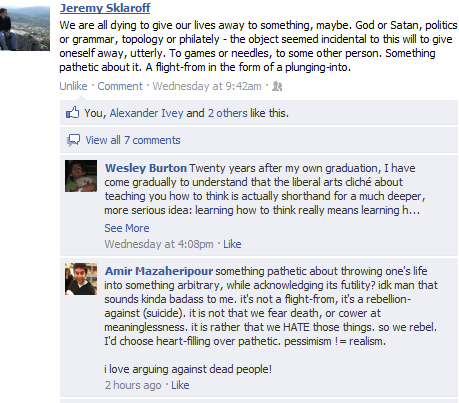
re: Sklaroff wall post
good job, but there's still something troubling about it
like, why does one throw one's entire self
rather than like, most of it
it's a suicide of a different type in that sense
if you give all of yourself to something
there's nothing left
hella selfless, I suppose
me
yeah
Zak
perhaps virtuous
in that sense
me
i mean i'm willing to go far as to say the self isn't really anything but a conglomeration of ones interactions with society or w/e
all existence is external
looking into the self one will not find much
that's why people get much happier helping other people (peace corps or w.e) than by helping themselves
....
______________
but ye in response to your response to my sklar comment
i guess what i mean is
there is no throwing 'most of ones self' into something
as long as you are not committing suicide
you are throwing your whole self into all of existence
whether thats just religion or like 5 things
doesn't change that fact
existence is all one anyways
human categories distinguish it
but once you say 'yes' to this moment,
you are saying yes to all of existence
does that make sense?
3:09 PM
Zak
i think i follow but maybe not that last "saying yes to the moment = yes to existence" bit
me
its the same thing as saying as long as you are not committing suicide
you are throwing your whole self into all of existence
Zak
and i kind of agree with the
you are what you do
you are what other people experience
me
and "existence is all one anyways"
there is only one binary
truth and nihilism
nihilism is a saying 'no' to the moment